PAIN-FREE BOMBS:
The Causation of and Prevention of of Common Golf Injuries
By Matthaus Taylor, MScPT Student (University of Alberta)
*Disclaimer: sometimes injuries happen from large increases in activity load, traumatic events or just sheer bad luck. Your chance of being injured is never zero! This blog post will be focused on:
How limitations in physical capacity can create an increased risk for some of the most common swing faults, as well as the some of the most common golf injuries**:
- The low back
- The elbow
- The wrist
- How physiotherapy and training can help to identify and shore up limitations in physical capacity, allowing you to swing fast and hit bombs more often!
**Note: depending on what source you look at, the above three areas of the body (low back, elbow and wrist) are almost always mentioned within the top six most injured areas for golfers (along with the upper back, shoulder and knee). I chose these three areas for two specific reasons:
-
From working at a golf course for 10+ years, these are the areas of the body I saw injured the most!
I have to keep this blog at a reasonable length! Maybe I’ll do part 2 at some point
Before We Get Started-Terminology to Understand:
- “Mobility”: the ability to actively change and control the position of body segments in a movement.
- Please note that mobility does not mean “flexibility”, which is how much a particular structure can passively stretch. Mobility has a strength and coordination component to it as well!
- As an example, with the help of a friend to push you into position, you may be able to make a backswing that resembles that of Rory McIlroy. However, if you can’t get there on your own, you don’t have the mobility to swing like Rory!
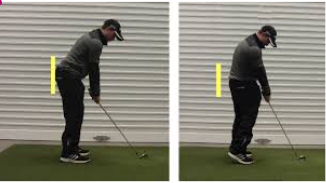
- Early extension*: the movement of the center of the pelvis towards the golf ball, particularly in the downswing.
- Internal/External Rotation of the Hips: while this is an anatomical term used to describe what is happening at the hip joint, let’s keep it simple and relate this to a golf swing. When your belt buckle turns towards a hip, that hip is in internal rotation. When your belt buckle turns away from a hip, that hip is in external rotation. Therefore, when you make a backswing, your lead hip moves into external rotation and your trail hip moves into internal rotation. The opposite occurs in the downswing.
“It’s All in the Hips”-Why Chubbs Was Right!
- The Hips + Swing Faults: According to Gulgin et al. (2013), early extension is significantly associated with the inability to:
- Touch your toes (aka hamstring flexibility)
- Hold a single-leg glute bridge (aka glute strength)
- The Hips + Low Back Pain: Significant correlations have been found between low back pain and decreased lead hip internal/external rotation in both golfers and tennis players (Vad et al., 2004). The reason behind this is quite simple actually-the less you can move at the hips, the more you tend to move through the lower back. Compared to those golfers that have 30+ degrees of lead hip internal rotation, golfers with less than 20 degrees of lead hip internal rotation showed more movement (flexion, trail side bend and rotation) during their swings in the lumbar spine (Kim et al., 2014). These same golfers showed reduced hip internal rotation strength.
- Big Takeway: lacking ROM and strength throughout the hips can pass stress onto your lower back and make you more likely to suffer common swing faults!
Why the (Overhead) Squat Tells A Lot:
- Poor Overhead Squat + Potential for Low Back Injury: Limitations in the ability to perform an overhead squat amongst single-figure handicaps lead to golfers utilizing more rapid lumbar extension throughout the downswing, which lead to a significant increase in peak shearing forces across the L4-L5-S1 joints (Chen et al., 2024). Now, it may be debatable as to whether this increase in shearing forces is predictive of injury, but it is certainly something to keep in mind, given that 95% of disc herniations happen at between L4-L5 or L5-S1 (Stretanski et al., 2025).
- Poor Overhead Squat + Potential for Swing Faults: Gulgin et al. (2023) found that golfers with poor overhead squat ability were 2-3 times more likely to show swing faults such as early extension and sliding. Additionally, Speariett and Armstrong (2019) found that the incidence of these swing faults were 90% for early extension and 80% for sliding amongst those golfers with poor overhead squat ability.
- The Practical Application: Does this mean that you have to turn into an Olympic weightlifter with the ability to do this?*
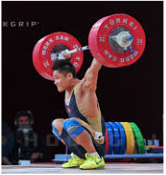
Of course not-putting these kinds of weights overhead is a feat that takes multiple years of intense training, great anthropometrics (e.g. body proportions) as well as heel-elevated squat shoes! However, what the Gulgin et al (2013) and Speariett and Armstrong (2019) studies indicate is that being able to perform a competent overhead squat with something as light as a broomstick or alignment stick is a major benefit when it comes to having the physical capacity to make an efficient golf swing. In fact, the previously mentioned Chen et al. (2024) study found that the ball speed was significantly higher amongst those with the best overhead squats when compared to the worst overhead squats. This shouldn’t be surprising when we break down what is required to do a decent overhead squat:
- a.) Solid core control (e.g. lumbopelvic stability)!
- b.) Good T-spine extension!
- c.) Good flexion range of motion at the hips, knees and ankles!
- Big Takeway: better physical capacity through the T-spine, core, pelvis, hips, knees and ankles=better swing characteristics with less stress through the low back=more bombs hit!
“The People’s Elbow”-A Downstream Effect
Limitations in lead hip internal rotation have been linked to shoulder and elbow injuries in overhead athletes (Jones & Safran, 2023). Sound familiar, yet? This should not be surprising, as speed/force in a good golf swing is generated from the core outwards, or as current literature and TPI likes to say “proximal to distal” sequencing. In a good golf swing, rotational velocities should peak in the order of hips-thorax-lead arm-club. This means that an inability to turn into the lead hip is an inefficiency that means power generation has to come more through the upper extremity. We see this in weekend warriors! Despite professional golfers having faster swing speeds than amateurs and hitting significantly more golf balls in practice, the elbow is the one area where amateur golfers are more frequently injured than professional golfers (Michal et al., 2025).
“Wrist Shot”-Another Downstream Effect
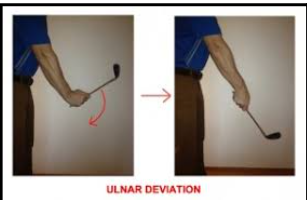
Common injuries at the wrist and hand include TFCC tears and De Quervain's Syndrome or “text thumb” (TPI Certified Medical Professional-Level 2 Manual-Medical Professional, 2012) . Essentially, a TFCC tear results from a compression of the wrist at the pinky side of the hand, where De Quervain’s tears result from a stretching of your “snuffbox” at the thumb side of the hand. In both cases, the culprit is something called excessive ulnar deviation. In simple golf language, this would be tilting your thumbs downwards to the ground while in your golf posture.
The 6 Actions of the Wrist & Forearms
While ulnar deviation occurs in high-level golf swings and is by no means a “boogeyman” to totally avoid, the magnitude of ulnar deviation is increased by swing faults such as early extension. Think about it-the more you stand up in the downswing, the more aggressively you will have to tilt those thumbs down to make contact with the ball. Early extension is the most common swing fault that affects 64% amateur golfers (TPI Certified-Level 1 Manual, 2012).
Which brings us full circle back to the start of this post. If you remember, early extension is associated with poor range of motion and flexibility at the hips, T-spine and core. Once again, another injury can be explained by Chubb's infinite wisdom of “it’s all in the hips!”
In the next section, let’s dive into some exercises to address limitations around the hips!
Exercises to Target the Hips, Core and T-Spine!: Videos can be found on Instagram at: @teamversamc · Calgary, AB
Note: for these exercises, think of “par” as an assistive stretch, “birdie” as a strength movement through a moderate + stable range, “eagle” as a strength movement through a larger + stable range, and “ace” as a strength movement that is more dynamic than the previous categories. These are not an end-all, be-all exhaustive list of exercises or an absolute master list of progressions, but rather examples of what training could look like at different parts along the mobility spectrum. Please note that mobility is not just flexibility, but involves the ability to actively control movement through a range of motion!
- Hip IR Examples:
- Par (Band-Assisted Windshield Wipers): 2 sets of 10-15 per side
- Birdie (Band Resisted Hip IR-Tabletop Position): 2 sets of 8-10 per side
- Eagle (Hip Airplane + Medial Support): 2 sets of 6-10 per side
- Ace (Rotational DB Rear-Foot Elevated Split Squat): 2 sets of 4-8 per side
- Hip ER Examples:
- Par (Weighted Figure 4 Stretch): 2 sets of 40s hold per side
- Birdie (Banded Fire Hydrant-Wall Supported): 2 sets of 10-15 per side
- Eagle (Weighted Pigeon Stretch): 2 sets of 8-10 per side
- Ace (Rotational DB Step Up): 2 sets of 4-8 per side
- T-Spine Extension Examples:
- Par (Foam Roller Facilitated T-Spine Extension): 2 sets of 1 rep per thoracic vertebrae
- Birdie (Unilateral Reach, Roll, Lift): 2 sets of 8-10 per side
- Eagle (Bear Hug Flexion/Extension from Deep Squat): 2 sets of 8-10
- Ace (Overhead Press from Deep Squat): 2 sets of 4-8
- Matt’s Personal Spice-Rotational/Core Stuff That I Frequently Use!
- Bear Hug Rotational Lunge: 2 sets of 8-10 per side
- Wall Contours (credit: @vernongriffith4): 2 sets of 30-40 seconds per side-combine whatever feels good!
- Plank + KB Saw: 2 sets of 30 seconds per side
- Lengthened-Biased Cable Core Rotation (credit: @alecblenis): 2 sets of 4-8 per side (may need a dip belt to weigh yourself down!)
A final aside: while this post has shown that many golfing injuries and swing faults can be related to limitations at the hips, other limitations throughout different parts of the body also can play a large role! Both Mat Thompson and Evan Baldwin are TPI certified and have the know-how to screen your physical capabilities and prescribe exercises to get you feeling your best and hitting pain-free bombs more often!
References
Chen, Z., Pandy, M., Huang, T., & Tang, W. (2024). Does Overhead Squat Performance Affect the Swing Kinematics and Lumbar Spine Loads during the Golf Downswing? Sensors, 24(4), 1252. https://doi.org/10.3390/s24041252
Gulgin, H. R., Schulte, B. C., & Crawley, A. A. (2013). Correlation of Titleist Performance Institute (TPI) Level 1 movement screens and golf swing faults. The Journal of Strength and Conditioning Research, 28(2), 534–539. https://doi.org/10.1519/jsc.0b013e31829b2ac4
Jones, S. D., & Safran, M. R. (2023). Current concepts: the hip, core and kinetic chain in the overhead athlete. Journal of Shoulder and Elbow Surgery, 33(2), 450–456. https://doi.org/10.1016/j.jse.2023.10.009
Kim, S., You, J. H., Kwon, O., & Yi, C. (2014). Lumbopelvic Kinematic characteristics of golfers with limited hip rotation. The American Journal of Sports Medicine, 43(1), 113–120. https://doi.org/10.1177/0363546514555698
Lindsay, D. M., & Vandervoort, A. A. (2014). Golf-Related Low Back Pain: A Review of Causative factors and Prevention Strategies. Asian Journal of Sports Medicine, 5(4), e24289. https://doi.org/10.5812/asjsm.24289
Michal, J., Straňavská, S., & Bolčíková, A. (2025). Comparison of the occurrence of musculoskeletal pain in professional and amateur golfers. Sport Mont, 23(03), 103–110. https://doi.org/10.26773/smj.251015
Sell, T. C., Tsai, Y., Smoliga, J. M., Myers, J. B., & Lephart, S. M. (2007). Strength, flexibility, and balance characteristics of highly proficient golfers. The Journal of Strength and Conditioning Research, 21(4), 1166. https://doi.org/10.1519/r-21826.1
Speariett, S., & Armstrong, R. (2019). The relationship between the Golf-Specific Movement screen and golf performance. Journal of Sport Rehabilitation, 29(4), 425–435. https://doi.org/10.1123/jsr.2018-0441
Stretanski, M. F., Hu, Y., & Mesfin, F. B. (2025, September 14). Disk Herniation. StatPearls - NCBI Bookshelf. https://www.ncbi.nlm.nih.gov/books/NBK441822/#:~:text=The%20incidence%20of%20HNP%20is,.%5B8%5D%5B9%5D
TPI Certified Medical Professional-Level 2 Manual-Medical Professional. (2012).
TPI Certified-Level 1 Manual. (2012).
Vad, V. B., Bhat, A. L., Basrai, D., Gebeh, A., Aspergren, D. D., & Andrews, J. R. (2004). Low back pain in professional golfers. The American Journal of Sports Medicine, 32(2), 494–497. https://doi.org/10.1177/0363546503261729

Lindsey
Contact Me