The Issue:
Dance has always been a popular activity for children and teens. Over the last decade, competitive dance training has become much more intense. Young dancers are now specializing earlier and often train 20–30 hours each week. Dancers spend many hours improving their technique, flexibility, and artistry. However, many young dancers are not doing structured strength training, which may be an important missing part of their overall training.
As dance becomes more physically demanding, it is important to understand how strength training can help support young dancers.
Strength Training and Dance: What the Research Says
Dance requires a combination of flexibility, strength, power and artistry (Dowse et al., 2020. Studio training often places emphasis on the artistic part of dance and thus dancers spend most of their time developing only dance-specific skills from a young age (Dowse et al., 2020). A lack of strength training in combination with the intensive dance-specific training loads has resulted in dancers having increased risk of muscular imbalance and potential for injuries as well (Dowse et al., 2020). Another thing to note is that research shows that dance-training alone is not preparing dancers well enough for the physical demands required in performance (Dowse et al., 2020). For example, dancers often perform big classical jumps which require high levels of flexibility, speed, strength, power and coordination in order to execute them properly (Dowse et al., 2020). Jumping ability is so important for dancers and often one of the best predictors of dance performance (Dowse et al., 2020). Training strength to help master jumps and other techniques is another benefit that strength training may have for dancers.
Overall, this suggests that strength training may have meaningful benefits for young dancers. So why isn’t it being used more in this population?
Dispelling Strength Training Myths:
Many dancers avoid strength training because of common misconceptions. One common belief is that strength training will create large bulky muscles that will ruin the aesthetics of their dancing.
Research does not show strong evidence that youth engaging in strength training will result in developing large muscles (Stracciolini et al., 2016). Instead, children who engage in strength training often see improvements in strength primarily through improved activation of muscle fibres, more efficient muscle firing, and improved coordination between muscles, rather than increases in muscle size (Stracciolini et al., 2016). This means that youth dancers can develop strength without necessarily developing large muscles as well.
Another common myth is that dancers simply do not need strength training because dance training is enough exercise. Dance-specific training does build some muscular strength for dancers; however, they often still present with muscular imbalances and areas of weakness. For example, research from Bennell et al. (1999) shows that when compared to non-dancers, youth dancers aged 8-11 years had overall less hip muscle strength.
This tells us that while dancers are putting in lots of time at the studio, they may not be developing the strength needed in all of the necessary muscle groups.
How physio can help:
Now that we understand why strength training is helpful for dancers, we need to understand how they can safely add it into their routines. This is where physiotherapists can help! Physiotherapists are trained in anatomy, exercise prescription, and movement analysis, and are well positioned to tailor exercise programs to an individual’s specific needs. In dancers, this may include assessing movement patterns, injury history, strength, flexibility, and identifying areas that require further development to meet their performance demands. From this assessment, physiotherapists can design and progress a strength training program that is specific to the dancer, with the goal of improving both performance capacity and injury resilience.
Strength Training Dancers Can Do:
Below are a few examples of exercises that physiotherapists may use to help dancers build strength and stability.
Core Stabilization:
Core stability generally refers to developing the ability to control our spine during movement (The Ballet Blog, n.d.-b). It requires fine coordination of all the trunk musculature and not only the abdominals and thus is important for dancers when they need to control an arabesque or improve their ability to turn (The Ballet Blog, n.d.-b).
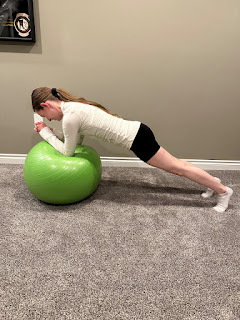
Example Exercise: Stir-the-pot Stability Ball Exercise
This would be an example of advanced core stabilization exercise because we have an unstable base for the dancer to work on developing core strength and stability. Dancers will start with their elbows propped on a yoga ball in a strong and supported plank position. They will then move their arms on the ball in small circular motions like they are “stirring a pot” whilst still maintaining a stable plank position.
Glute Strengthening:
Many movements in dance require hip extension which is a movement powered by the glutes.
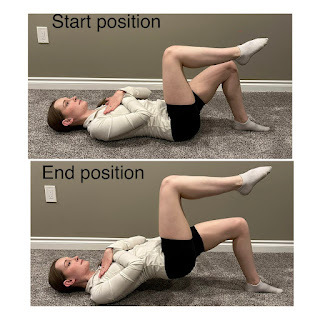
Example Exercise: Single Leg Parallel Glute Bridge
A single leg parallel glute bridge allows the dancers to build strength in the glutes in a position that also requires them to single-leg position that also requires them to maintain stability.The dancer lies on their back with one knee bent and the other leg raised. They then push through the glutes to lift their hips into a bridge position while maintaining balance and control.
Peroneal Strengthening:
We have three muscles along the outside of our lower leg that are important for helping to stabilize our ankle and prevent it from rolling inwards. Often, younger dancers may struggle to maintain proper alignment of their feet when they go up on relevé and may find their ankles rolling in (The Ballet Blog, n.d-a). Strengthening of our peroneal muscles can help improve this alignment and prevent this.
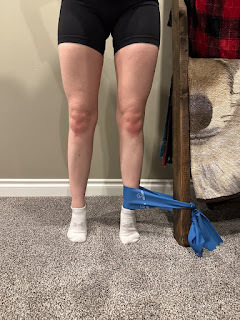
Example Exercise: Rises With Resistance Band.
A resistance band is attached to the inside of the ankle and anchored to a stable object. The dancer rises onto their toes while resisting the inward pull of the band. This exercise helps strengthen the ankle stabilizers and improve alignment.(The Ballet Blog, n.d.-a)
Back Strengthening:
Upper back strength is important for posture and arm control during movements such as port de bras.
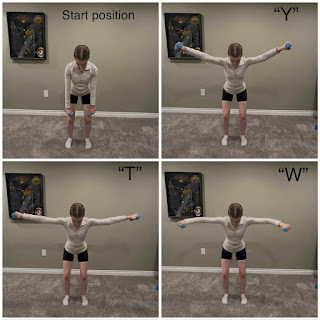
Example Exercise: Standing Y-T-W
This exercise helps dancers strengthen a number of muscles within their upper and mid back. The Y and T positions help activate muscles such as our lower and middle fibre trapezius, whereas a muscle like the rhomboids is more active during the T and W positions when we have to pull back our shoulders. Dancers begin by standing with feet parallel and hips hinged to 45 degrees, a small weight can be placed in hands for additional challenge. They will then begin to move through the Y then the T and the W Positions respectively.
Here is a video link with a demonstration:
Key Take Aways:
Strength training is an important part of a dancer’s overall development. It can help improve performance, increase stability, and reduce the risk of injury. However, many young dancers still do not include enough strength training in their routines.The exercises listed above are only a few examples of how dancers can build strength safely in different body areas. Physiotherapists, like the team at VersaMC, can individually assess each dancer and develop a strength program tailored to their specific needs and goals.
Written by Sydney Gray, Physiotherapy Student at the University of Alberta.
References
Bennell, K., Khan, K. M., Matthews, B., De Gruyter, M., Cook, E., Holzer, K., & Wark, J. D. (1999). Hip and ankle range of motion and hip muscle strength in young female ballet dancers and controls. British Journal of Sports Medicine, 33(5), 340–346. https://doi.org/10.1136/bjsm.33.5.340 Dowse, R. A., McGuigan, M. R., & Harrison, C. (2020). Effects of a resistance training intervention on strength, power, and performance in adolescent dancers. Journal of Strength and Conditioning Research, 34(12), 3446–3453. https://doi.org/10.1519/JSC.0000000000002288 Stracciolini, A., Hanson, E., Kiefer, A. W., Myer, G. D., & Faigenbaum, A. D. (2016). Resistance training for pediatric female dancers. Journal of Dance Medicine & Science, 20(2), 64–71. https://doi.org/10.12678/1089-313X.20.2.64 The Ballet Blog. (n.d.-a). The top 5 ways to use a resistance band. https://theballetblog.com/shop/the-top-5-ways-to-use-a-resistance-band-free-pdf/ The Ballet Blog. (n.d.-b). The truth about core stability. https://theballetblog.com/portfolio/the-truth-about-core-stability/

Lindsey
Contact Me